
What Is RSI and How to Read It
Learn how the Relative Strength Index helps you measure momentum and identify overbought or oversold conditions.
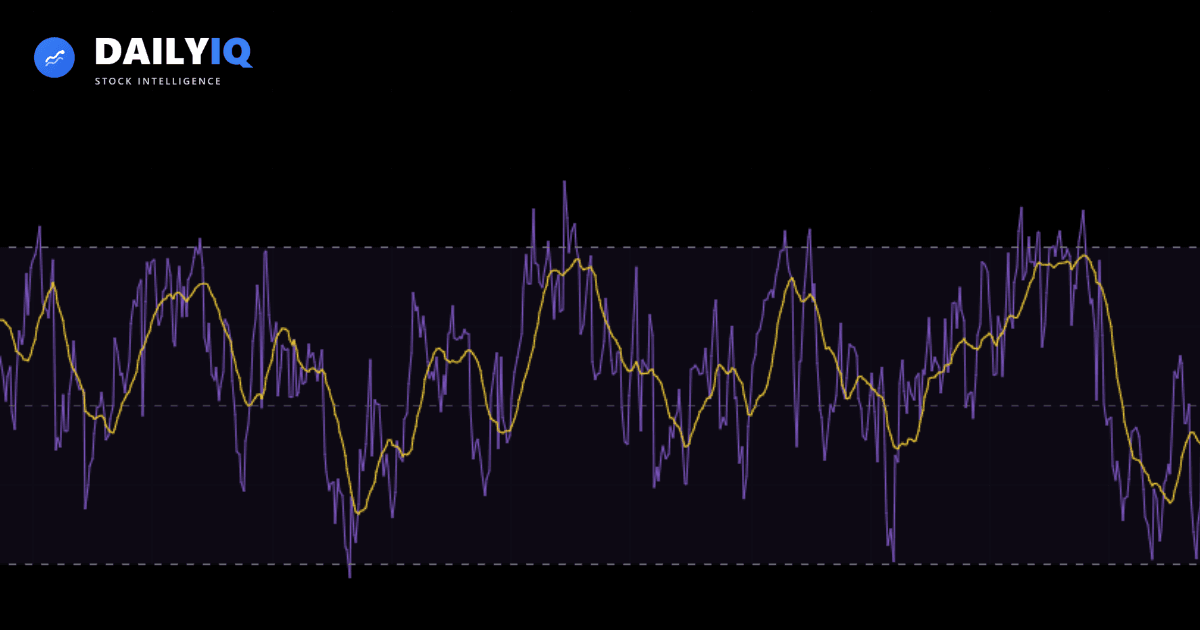
Introduction To What Is RSI and How to Read It
RSI is most useful when you read it in context - not as an automatic buy or sell trigger, but as a window into how much momentum is behind a move.
The Relative Strength Index (RSI) is one of the most widely used momentum indicators in technical analysis. It helps traders understand how strong recent price movements are and whether that strength may be stretched too far in one direction.
RSI is displayed as an oscillator, meaning it moves within a fixed range between 0 and 100. Instead of following price directly, it measures the speed and magnitude of recent gains versus recent losses. By doing so, it gives traders insight into momentum conditions that are not always obvious from price alone.
When price rises aggressively, RSI increases. When price falls sharply, RSI decreases. The indicator helps answer a simple but important question:
Is momentum accelerating, weakening, or becoming overextended?
RSI does not predict the future by itself. Instead, it provides context - helping traders judge whether a move is strong, weakening, or potentially stretched.
How RSI works
RSI is most commonly calculated using 14 periods. On a daily chart, that means 14 trading days. On a 1-hour chart, it means 14 hours.
The standard formula is:
RSI = 100 - (100 / (1 + RS))
Where:
RS(Relative Strength) equals the average gain divided by the average loss over the chosen lookback period.
The calculation works in two main steps:
- Measure the average gains and average losses over the last 14 periods.
- Compare those values to determine the strength of buying pressure relative to selling pressure.
If gains are larger than losses, RSI rises.
If losses are larger than gains, RSI falls.
The output always stays between 0 and 100:
- Near 0 → very strong downside momentum
- Near 100 → very strong upside momentum
Because RSI is smoothed, it does not jump instantly. It responds gradually as new price data is added.
Reading RSI signals
RSI is typically interpreted using three main zones: overbought, oversold, and neutral.
Overbought zone (above 70)
An RSI reading above 70 is traditionally considered overbought. This suggests that recent buying pressure has been strong and may be becoming stretched.
However, “overbought” does not mean price must fall immediately.
In strong uptrends, RSI can remain above 70 for extended periods while price continues climbing. This is known as “riding momentum.” Selling simply because RSI is above 70 can lead to exiting strong trends too early.
Instead, traders often treat high RSI readings as:
- A caution signal
- A possible sign of short-term exhaustion
- A reason to tighten risk management
Context matters. In a powerful bullish trend, high RSI may confirm strength rather than warn of reversal.
Oversold zone (below 30)
An RSI reading below 30 is traditionally considered oversold. This suggests strong recent selling pressure.
In range-bound markets, oversold conditions can lead to rebounds. Traders sometimes look for price stabilization and confirmation signals when RSI drops below 30.
However, just like with overbought conditions, oversold does not automatically mean price will bounce.
In strong downtrends, RSI can remain below 30 for extended periods while price keeps falling. Buying too early in these conditions can be risky.
Instead, oversold RSI often signals:
- Heavy bearish momentum
- Potential exhaustion
- A need for confirmation before entering trades
Neutral zone (30 to 70)
The area between 30 and 70 is often overlooked, but it provides important trend information.
In healthy uptrends:
- RSI often stays between 40 and 80.
- Pullbacks may stop near 40–50 before momentum resumes upward.
In strong downtrends:
- RSI may remain between 20 and 60.
- Rallies may fail near 50–60 before downside momentum returns.
The middle range can help traders identify whether momentum is strengthening or weakening within an existing trend.
For example:
- Rising RSI from 45 to 60 suggests strengthening bullish momentum.
- Falling RSI from 55 to 40 suggests increasing bearish pressure.
RSI divergence
One of the most powerful RSI concepts is divergence.
Divergence occurs when price and RSI move in opposite directions.
Bullish divergence
- Price makes a lower low.
- RSI makes a higher low.
This suggests that downside momentum is weakening even though price is still falling. It can signal a potential reversal or bounce.
Bearish divergence
- Price makes a higher high.
- RSI makes a lower high.
This suggests that upside momentum is weakening even though price continues rising.
Divergence is not a guaranteed reversal signal. In strong trends, divergence can appear multiple times before price actually turns. However, it often provides early warning that momentum is shifting.
RSI in trending vs ranging markets
RSI behaves differently depending on market structure.
In range-bound markets, RSI tends to move predictably between 30 and 70. Overbought and oversold signals are more reliable in these conditions.
In strong trending markets, RSI signals can produce false reversals. Instead of focusing on 30 and 70, traders often adjust expectations:
- In uptrends, RSI pullbacks toward 40–50 can act as support.
- In downtrends, RSI rallies toward 50–60 can act as resistance.
Understanding market structure helps avoid misinterpreting RSI readings.
RSI vs other indicators
RSI measures momentum. It does not measure trend direction directly.
For that reason, many traders combine RSI with:
- Moving averages (to identify trend)
- Support and resistance levels
- Volume analysis
- MACD (to compare momentum perspectives)
RSI works best as part of a system rather than a standalone signal.
How DailyIQ uses RSI
DailyIQ shows RSI in each stock's indicator breakdown. The Technical Score itself ranks momentum across the stock universe and does not use RSI. An RSI reading of 75 means very different things in a strong uptrend versus a weakening one. Without structural context, the number alone is not actionable.
An expanding RSI in an established trend is confirmation. RSI that fails to make a new high while price does is a quiet warning - not a reason to sell, but a reason to watch more carefully.
Practical takeaways
RSI works best as a context tool, not a trigger. The most useful habit is to read it alongside the trend rather than instead of the trend.
Use overbought and oversold zones as questions, not answers. Above 70 asks: "Is this strength or exhaustion?" Below 30 asks: "Is this capitulation or continuation?" The trend and price structure answer those questions.
Watch for divergence at key levels - not in open air. Divergence at a major support or resistance area carries more weight than divergence in the middle of a range. And always define your exit before entering - RSI tells you about momentum, not where momentum will stop.
RSI settings and customization
The default 14-period RSI is the most widely used setting, and for good reason: it balances sensitivity with smoothness across most instruments and timeframes. A shorter lookback period — such as 9 periods — makes RSI more responsive, generating more frequent signals and more extreme highs and lows. A longer lookback — 21 or 25 periods — creates a smoother oscillator that is less prone to noise but slower to confirm momentum shifts.
The practical impact of changing the period is meaningful. On a 9-period RSI, readings above 70 and below 30 occur far more frequently, which makes those thresholds less meaningful as signals. On a 21-period RSI, the same thresholds are reached less often and may carry more weight when they are.
For scalping and very short-term trading on intraday charts, a faster RSI (7-9 periods) can improve responsiveness without creating excessive lag. For swing traders using daily charts, the default 14-period is generally appropriate. For long-term investors using weekly charts, a 21-period RSI can help filter noise while still capturing meaningful momentum shifts.
Adjusting overbought and oversold thresholds
The 70 and 30 thresholds are conventions, not laws. In strong trending markets, many traders adjust these thresholds:
- In strong uptrends: treat 40 as the oversold threshold (not 30) and 80 as the overbought threshold (not 70)
- In strong downtrends: treat 60 as the overbought threshold and 20 as the oversold threshold
This calibration acknowledges that RSI oscillates within different ranges depending on the regime. Keeping the original 30/70 thresholds during a confirmed uptrend causes traders to either miss valid entries or exit trends prematurely.
RSI failure swings
RSI failure swings are one of the lesser-known but more reliable RSI signal types. They were identified by J. Welles Wilder Jr. in his original work and represent a pattern where RSI itself — not price — signals a reversal.
Bullish failure swing
- RSI drops below 30 (oversold)
- RSI bounces back above 30
- RSI pulls back again but holds above the prior low (higher low)
- RSI breaks above the prior bounce high
This sequence shows that selling pressure was unable to push RSI to a new low. The failure to make a lower low in the oscillator precedes a bullish turn in price.
Bearish failure swing
- RSI rises above 70 (overbought)
- RSI pulls back below 70
- RSI rallies again but fails to reach the prior high (lower high)
- RSI breaks below the prior pullback low
This pattern signals that buying pressure is exhausted. The inability to push RSI to a new high often precedes a bearish price turn.
Why failure swings matter
The critical distinction with failure swings is that they are based entirely on RSI's own structure — the signal does not require price to make a specific high or low. This makes failure swings more objective than classic divergence, which can be visually ambiguous depending on which price swings are compared.
Failure swings tend to be most reliable when they occur at major price levels: a bullish failure swing at key support, or a bearish failure swing near significant resistance, carries more weight than the same pattern in open space.
RSI with volume and price structure
RSI becomes significantly more powerful when combined with volume analysis and price structure context. A momentum reading in isolation tells you whether recent gains outpace losses — but it cannot tell you whether that momentum is backed by genuine conviction or thin-market noise.
Volume-confirmed RSI signals
When RSI rises into overbought territory on expanding volume, the move reflects broad participation and is more likely to continue in the direction of the trend. When RSI reaches overbought levels on declining volume, buying pressure is thinning — the move may be running on fumes even though the RSI number looks strong.
The same principle applies in reverse: RSI dropping into oversold on massive volume spike (capitulation) is often more significant than RSI grinding toward 30 on average volume. Volume capitulation into RSI extremes creates a more powerful potential reversal setup.
RSI at key structural levels
RSI divergence or failure swings carry far more weight when they appear at identifiable chart levels:
- Bullish divergence at prior major support, multi-year lows, or long-term moving averages
- Bearish divergence at prior major resistance, 52-week highs, or prior breakdown areas
RSI divergence in the middle of a clean trend, without any structural reference point nearby, is a weaker signal than the same divergence where price is testing a meaningful level. The structural level tells you why price might react there; the RSI divergence tells you that momentum is flagging at that location.
Combining RSI with MACD
MACD and RSI measure related but distinct aspects of momentum. RSI compares the magnitude of gains versus losses; MACD measures the convergence and divergence of moving averages. When both indicate the same directional bias simultaneously — both showing bullish divergence, or both improving from oversold levels — the alignment creates a higher-confidence setup than either indicator alone.
When RSI and MACD disagree — for example, RSI recovering while MACD is still declining — it is usually better to wait for alignment before committing to a position.
RSI across multiple timeframes
One of the most productive ways to use RSI is to check it across multiple timeframes before making any trading decision. The timeframes you examine should match your intended holding period, with the longer timeframe defining the regime and the shorter timeframe providing entry timing.
Weekly RSI as a regime filter
Weekly RSI establishes the broader momentum regime for swing trades and medium-term positions. A stock with weekly RSI above 50 and trending upward is in a bullish momentum regime — it is appropriate to look for buying opportunities on short-term weakness. A stock with weekly RSI below 50 and declining is in a bearish momentum regime — short-term recoveries are more likely to fail near resistance than to turn into new uptrends.
This weekly RSI filter alone eliminates many failed trades because it prevents buying pullbacks in stocks with overall bearish momentum, which are often traps rather than genuine entries.
Daily RSI for setup identification
Once the weekly RSI establishes the regime as bullish, the daily RSI identifies the specific setup conditions. The best daily setups in bullish regimes tend to occur when:
- Daily RSI has pulled back from overbought toward the 40-50 zone (the 'trend zone')
- RSI is turning upward from a mid-range level, not from an already overbought position
- The turn coincides with a price test of a meaningful support level (moving average, prior breakout area)
Intraday RSI for entry timing
For traders who work with intraday charts, the hourly or 4-hour RSI can help time entries within the daily setup. An intraday RSI that is recovering from oversold while the daily setup is constructive provides a more precise entry signal than simply buying the day's open. This multi-timeframe alignment concentrates exposure at points of higher probability rather than spreading it across the whole day.
Common RSI mistakes
Understanding what not to do with RSI is as valuable as knowing what to do. These are the most frequent RSI errors, presented as a practical checklist.
Treating overbought as an automatic sell signal: In trending markets, overbought RSI often reflects strength, not exhaustion. The error costs traders early exits from the best-performing positions.
Treating oversold as an automatic buy signal: In downtrends, RSI can remain below 30 for weeks. Buying every dip into oversold territory during a downtrend leads to repeated losses. Oversold without structural support and a reversal trigger is not enough.
Acting on divergence without confirmation: RSI divergence can appear many times before price actually turns. A single divergence signal without a corresponding structural break, volume shift, or failure swing is insufficient reason to enter a counter-trend position.
Using the same RSI settings across all assets and timeframes: A 14-period RSI on a 5-minute chart behaves very differently from 14-period RSI on a weekly chart. RSI settings should be calibrated to the asset's volatility and the trader's timeframe.
Ignoring the broader trend when interpreting RSI: An RSI reading of 65 has a completely different meaning in a confirmed uptrend (bullish, near the upper end of the trend's normal range) versus a confirmed downtrend (potentially a failing rally that should be sold). Context determines meaning.
Watching RSI without watching price: RSI is a derived indicator — it is a mathematical transformation of price. Price action, structure, and volume should always be the primary inputs; RSI is the confirmation layer.
Read RSI Within Trend Structure
RSI above 70 in a strong uptrend often confirms strength - it does not automatically call a top. The same reading in a weakening trend is a very different signal. Always establish trend direction before interpreting RSI levels.
Use Divergence as an Early Warning
When price makes a new high but RSI makes a lower high, momentum is quietly fading. Divergence does not guarantee reversal, but it tells you the move is becoming less supported - a reason to tighten risk, not necessarily exit outright.
Adjust RSI Ranges for Trending Markets
In uptrends, RSI often oscillates between 40 and 80 rather than 30 and 70. Treating a pullback to 45 as "oversold" in a bull trend can mean exiting too early. Calibrate your expectations to the regime you are actually trading in.
Quick FAQ
Does RSI above 70 always mean sell?
No. In strong uptrends, RSI can stay elevated while price continues higher. Treat high RSI as context, then look for weakening structure before fading momentum.
How should I use RSI divergence in practice?
Use divergence as an alert to tighten risk, not an automatic reversal trade. Confirmation should come from price structure and follow-through.
Should RSI levels change in trending markets?
Yes. Uptrends often hold higher RSI ranges (for example, pullbacks near 40-50), while downtrends often cap lower (for example, rallies near 50-60).
Which timeframe gives the best RSI signals?
Signals are generally cleaner on higher timeframes. Lower timeframes react faster but produce more noise and more false swings.
What is the most common RSI mistake?
Treating overbought or oversold as standalone entries without trend context, location, and risk planning.
RSI across the market right now
Across the 1,050 symbols DailyIQ currently tracks with this metric, the median reads 47.4. The middle 80% of the market sits between 32.5 and 62.7, with the full range running from 11.2 to 82.2. Right now 29 symbols read above 70 and 64 below 30 — which is the practical answer to how common that condition actually is, rather than how common the textbook implies.
Computed across DailyIQ's tracked universe and refreshed through the trading day. Figures describe the current cross-section, not a recommendation.
Definition and thresholds: RSI (Relative Strength Index)
DailyIQ publishes market education, score methodology, and research workflows to help users understand what the platform is measuring. Content is for informational purposes only and is not investment advice or a recommendation to buy or sell any security.
Use education with process, not in isolation
See how DailyIQ combines technical indicators, news sentiment, freshness checks, and editorial review to decide what gets surfaced and indexed.
Learn About Investing
These resources can help investors evaluate momentum, volatility, and trend strength when analyzing What Is RSI and How to Read It.
 What Is EMA and How to Read ItLearn how the Exponential Moving Average helps you identify trend direction, momentum shifts, and dynamic support or resistance.Technical · 16 min read
 What Is ATR and How to Use ItLearn how the Average True Range (ATR) measures volatility and helps you set smarter stop losses and position sizes.Volatility · 16 min read
 What Are Heikin Ashi Candles and How to Read ThemLearn how Heikin Ashi candles smooth price action to help you identify trend strength, momentum shifts, and cleaner entries.Technical · 6 min read
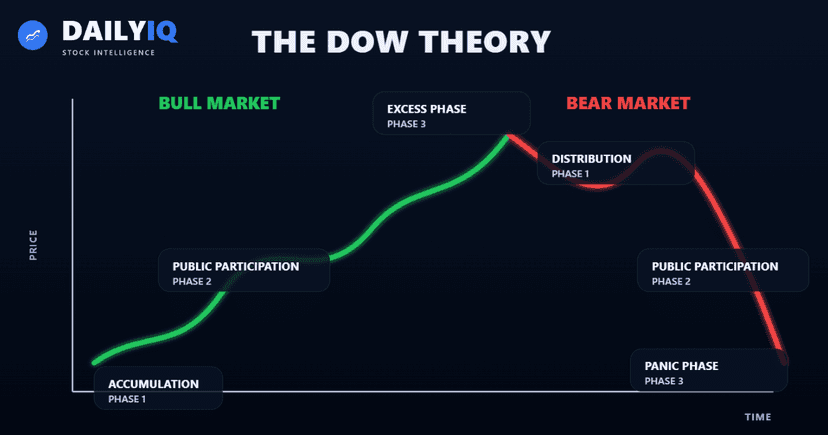 Dow Theory History, Theorems, Trends, Confirmation, Volume & CriticismsA comprehensive and original deep dive into Dow Theory, including its historical roots, core theorems, trend classifications, confirmation principles, volume interpretation, criticisms, and modern relevance.Technical · 24 min read
 How to Use DailyIQ Email Alerts to Time Your Buys and SellsA practical walkthrough of what's inside a DailyIQ email alert and how to use the target price and upside percentage to time entries, exits, and rotations.Strategy · 9 min read