
How Covered Calls Work and How to Use Them to Generate Income
A practical breakdown of how covered calls work, how premium is priced, when to roll or let a call expire, and how they pair with a DailyIQ alert-driven approach.
Introduction To How Covered Calls Work and How to Use Them to Generate Income
In the DailyIQ email alerts guide, we mentioned buying 100-share lots off a Top 6 pick and selling a call against them right away. This article is about how that actually works: what a covered call is, how the premium gets priced, when to roll versus let it expire, and how it fits into an alert-driven approach.
A covered call is an option you sell against 100 shares you already own, collecting premium in exchange for capping your upside at the strike price. The longer the call, the more premium, but also the more upside you're giving away.
What it is
Selling someone the right to buy your shares at a set strike by a set date, backed by 100 shares you own.
What you get
Premium credited to your account immediately, but your upside is capped at the strike.
How we use them
Sold at most a month out, a week out is the sweet spot when pairing with DailyIQ alerts.
What a covered call actually is
An option you sell (a short call position) that is backed by 100 shares of the underlying stock you already own. Selling it means you're giving someone else the right to buy your shares at a chosen strike price by a chosen date.
Covered calls can only be sold in lots of 100 shares. The longer the option is sold out for, the more premium you collect, but you're also locked into that trade-off for longer.
Option premiums are quoted per share, and one contract covers 100 shares, so every cent of quoted premium equals one dollar of actual premium collected. A call sold for $1.22 pays $122. A call sold for $0.53 pays $53.
Duration: how far out to sell
When pairing covered calls with DailyIQ alerts, sell at most a month out. A week out is the ideal window.
Picking a strike
Strike selection depends on how you actually feel about the stock at the time.
If you're pulling back on the equity itself, the further out of the money the strike, the better.
If you're genuinely 50/50 on the stock, roll close to the current strike price, even into the money.
If you're very bullish, sell out of the money to keep more of the upside. A dollar move up in the stock is always worth more to you than a dollar of extra premium from selling a lower strike.
A real example: rolling a DRAM covered call
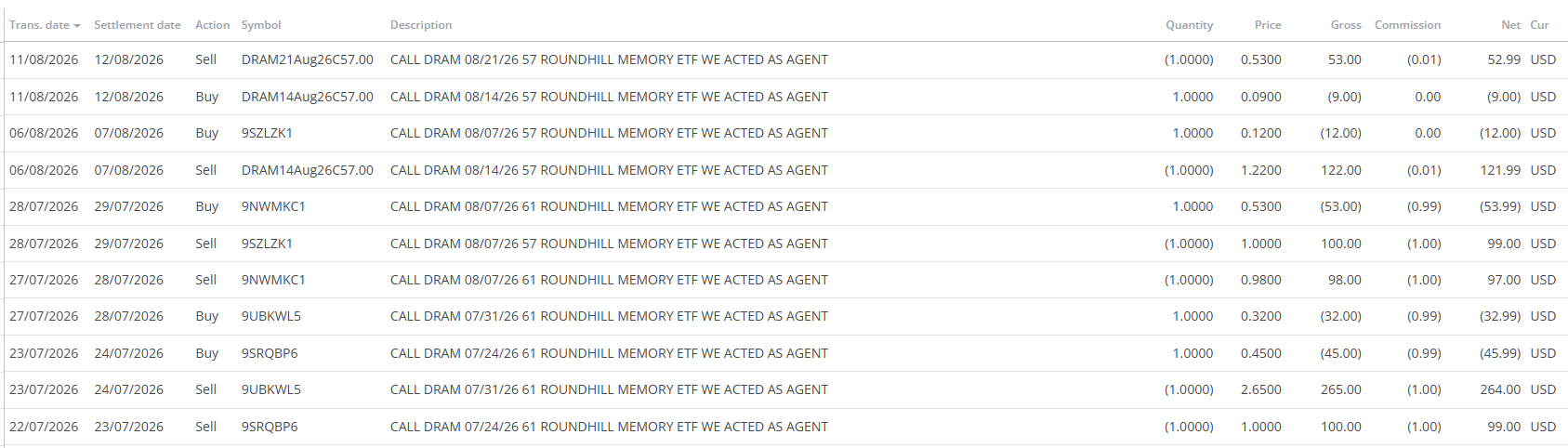
Here's an actual sequence from a DRAM position, backed by 100 shares in a margin account:
- 1Sell the call
Sold the DRAM $57 call expiring 8/14 for $1.22 per share, collecting $122 in premium.
- 2Watch it decay
Five days later, the same call had dropped to $0.09, worth almost nothing.
- 3Close it early
Bought it back for $9, locking in $113 of the $122 in just 5 days, well past the point of being up big early.
- 4Roll into the next week
Immediately sold a new $57 call expiring 8/21 for $0.53, collecting another $53 in premium.
| Action | Contract | Price | Amount |
|---|---|---|---|
| Sell | DRAM 8/14 $57 call | $1.22 | +$122 |
| Buy to close | DRAM 8/14 $57 call | $0.09 | -$9 |
| Sell (roll) | DRAM 8/21 $57 call | $0.53 | +$53 |
That's the core loop: sell, let it decay, close it once it's captured most of its value, roll into a new week.
When to close, roll, or just let it expire
You generally want to close a covered call you've sold when you're up around 50% on it within the first couple of days, then roll down the strike or roll it out another week. Otherwise, let it ride until it's basically worthless and roll out from there.
Normally, buying back a call specifically to dodge assignment isn't the move. If it looks like it's going to get assigned, that's fine, the strike price was one you were already happy selling at when you opened the position. The one infrequent exception is when you're very confident in a reversal and want to roll to the same strike for another week to keep the shares for a bigger expected upside.
Volatility drives premium
The more volatile the stock, the more you make selling calls against it. A low-volatility, stable name won't pay much premium at all. Something like HIMS, or memory-sector names during a period of heavy movement, pays significantly more, because the option premium is compensating for that extra risk and price movement.
The trade-off: capped upside
What you get
- Premium is credited to your account right away
- Consistent income on shares you're already holding
- Elevated premium around earnings and big announcements
What you give up
- Your upside is capped at the strike price
- Elevated premium around inflection points exists because of real volatility risk
- A big move (a 40% run, for example) can pass you by entirely if you sold a call for a small amount of extra premium going into it
Around inflection points like earnings or a major announcement, premiums get rich because of the added risk and volatility. That richer premium is tempting, but it's also the exact moment a stock is most likely to make the big move that a covered call caps you out of.
Selling covered calls inside a TFSA
Covered calls are generally allowed in a TFSA at most Canadian self-directed brokers, unlike naked options. The reason comes down to collateral: a covered call is backed by shares you already own, so there's no margin or short exposure involved. A naked call, on the other hand, would require the ability to borrow or short, which a TFSA doesn't allow.
What to confirm before writing covered calls in a TFSA
- Your broker has approved you for options trading on that account, usually at a basic "Level 2" tier that covers covered calls
- The underlying stock or ETF is a qualified investment for a TFSA
- The 100 shares you're writing the call against are actually held in that same TFSA
The CRA can reclassify a TFSA as carrying on a business if the trading pattern looks too frequent, sophisticated, or speculative, which puts the account's tax-free status at risk on those gains. Selling a covered call against a long-held position is generally viewed as more conservative than active options speculation, but rolling weekly on a large scale is worth thinking about in that context.
What it looks like in a real portfolio
Covered calls work across account types, margin, cash, and registered accounts alike, since the position is backed by shares rather than margin. See the TFSA section above for the specific brokerage and CRA considerations.
Putting it together
Key Takeaways
- A covered call is premium collected in exchange for capping your upside at the strike, backed by 100 shares you own.
- Sell at most a month out, a week out is the sweet spot when pairing with DailyIQ alerts.
- Pick your strike based on conviction: further OTM when pulling back or very bullish, closer to current price when genuinely 50/50.
- Close and roll once you're up around 50% early, otherwise let it ride toward worthless and roll from there.
- Assignment isn't something to fear, it's the price you already agreed to sell at.
- More volatile names pay more premium, but the trade-off is a capped upside on exactly the moves that matter most.
Before you sell your first covered call
- Own at least 100 shares of the underlying stock
- Decide your conviction level on the name to pick a strike
- Keep duration to a month or less, a week is ideal
- Be genuinely comfortable selling at the strike price if assigned
Quick FAQ
How much premium do I actually collect?
Options are quoted per share, and one contract covers 100 shares, so every cent of quoted premium equals one dollar. A call sold for $0.53 pays $53.
What happens if my shares get assigned?
You sell your shares at the strike price you chose when you opened the position. If you were comfortable with that price at the time, assignment isn't a problem, it's the outcome you already agreed to.
Can I sell covered calls in a TFSA?
Generally yes, at most Canadian self-directed brokers, since the call is backed by shares you already own rather than margin. You'll need options approval on that account first, and it's worth keeping the activity occasional rather than systematic, since the CRA can reclassify a TFSA as a business if trading looks too frequent or speculative.
Why do I get more premium on a volatile stock than a stable one?
Premium compensates for risk. A stock that moves a lot has a wider range of possible outcomes by expiration, so the option is worth more.
DailyIQ publishes market education, score methodology, and research workflows to help users understand what the platform is measuring. Content is for informational purposes only and is not investment advice or a recommendation to buy or sell any security.
Use education with process, not in isolation
See how DailyIQ combines technical indicators, news sentiment, freshness checks, and editorial review to decide what gets surfaced and indexed.
Learn About Investing
These resources can help investors evaluate momentum, volatility, and trend strength when analyzing How Covered Calls Work and How to Use Them to Generate Income.
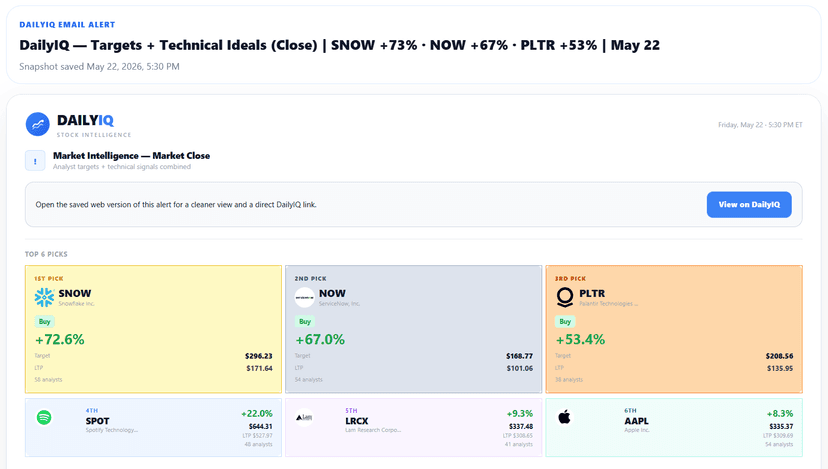 How to Use DailyIQ Email Alerts to Time Your Buys and SellsA practical walkthrough of what's inside a DailyIQ email alert and how to use the target price and upside percentage to time entries, exits, and rotations.Strategy · 9 min read
 Questrade vs Wealthsimple: Which Is Better for Active TradersA practical comparison of Questrade and Wealthsimple, focused on USD account holdings, options access, fees, and the platform features that matter most for active traders.Strategy · 8 min read