
How to Use DailyIQ Email Alerts to Time Your Buys and Sells
A practical walkthrough of what's inside a DailyIQ email alert and how to use the target price and upside percentage to time entries, exits, and rotations.
Introduction To How to Use DailyIQ Email Alerts to Time Your Buys and Sells
DailyIQ email alerts are a paid subscription feature that deliver a curated Top 5 list of equities directly to your inbox, twice a day. This guide is not about the algorithm behind the picks. It is for two kinds of readers: someone who has never gotten a DailyIQ alert before and wants to know what it actually looks like, and someone already subscribed who wants a guide on how to use it for the strongest returns.
An alert's target price is a reference point, not a hold-until instruction. Use the alert to confirm a stock has momentum and fundamental support, then manage your own entry, exit, and rotation based on how the position actually behaves.
What you get
Two alerts a day, before market open and before market close, each with a Top 5: last traded price, target price, and implied upside.
Fast movers
Up 7 to 10% in the first 3 days? That is usually a sell signal, not a hold signal.
Slower movers
Give it a week or more and aim to capture 25 to 30% of the gain, or roll covered calls while you wait.
What's inside an alert
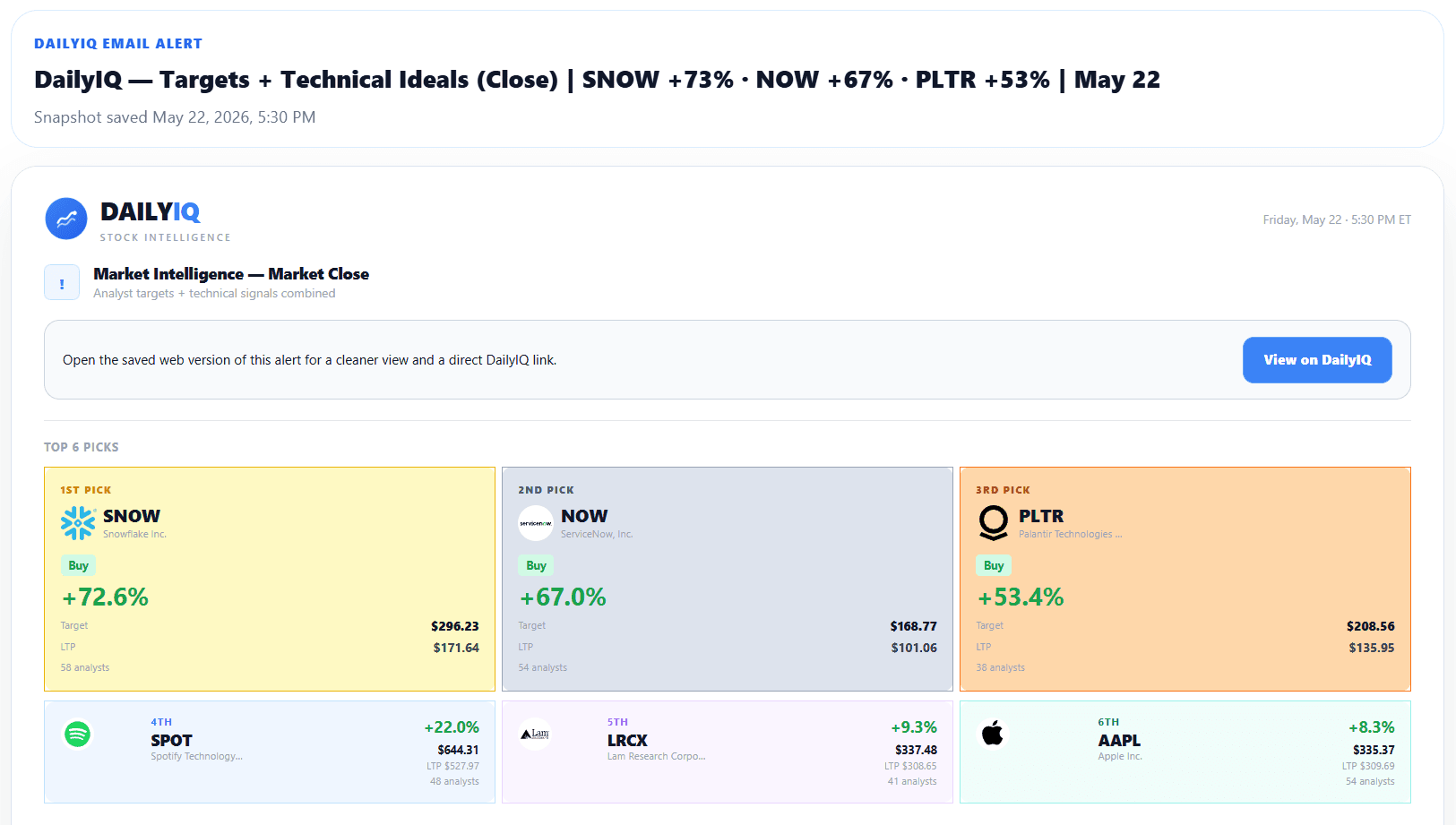
DailyIQ email alerts are part of a paid subscription. The example below is a real alert we sent, shown here to illustrate what subscribers receive.
Alerts go out twice a day, once before market open and once right before market close. Each one delivers a "Top 5" list, a curated podium of equities pulled from the universe of companies our team tracks. The picks combine two signals: momentum and fundamental strength. For every stock in the Top 5, you get the last traded price (LTP), a target price, and the implied upside to that target. Buy is the only rating that appears in the Top 5.
The composition often changes between alerts. If you see the same name repeated across multiple alerts, that is usually a sign of a consistent trend rather than noise. But even a name that only appears once still means the algorithm judged it a good buy at that specific time, and most of the time it is.
How to act on an alert
- 1Open the alert
Read through the full Top 5 list, not just the first pick.
- 2Check the price and target
Note the last traded price, the target price, and the upside percentage for each name that interests you.
- 3Decide your time horizon
Are you looking for a quick move over a few days, or a swing position you plan to hold for a week or more? Your exit rule depends on which one this is.
- 4Manage the exit, not just the entry
Use the fast-mover rule or the gradual-capture rule below, depending on how the position actually behaves after you buy.
Don't hold to the target price
The target price is a reference point, not a hold-until instruction. This matters especially if you are running a swing trading approach: the goal is to rotate through profitable positions, not park in one stock waiting for it to hit its number. The alert's real value is confidence that what you are buying has positive momentum and is fundamentally sound, not a promise of an eventual payout at that exact price.
Timing your exit
A price gap left behind when a stock moves very quickly in one direction. When the market later fills that gap, it can erase the quick gains that created it.
If a stock is up 7 to 10% within the first 3 days of buying, that is a signal to sell. When a move happens that fast, it tends to leave a fair value gap behind it, and when that gap gets filled, the quick gains just made can get wiped out. Taking profit before that happens protects what you earned.
When a position takes a week or more to develop instead of a few days, the approach shifts: try to capture as much of the gain as possible. In practice that is usually somewhere between 25 and 30% of the position's gain, depending on whether the stock keeps climbing, whether something more interesting shows up elsewhere in the market, and general judgment at the time.
We do not currently have a built-in way to tell users exactly when to take profit on a specific position. If you want individualized guidance, our team is reachable 24/7 through Contact Us.
When a pick just sits there
Not every position moves right away, and that is fine. What you do next depends on whether you can sell covered calls against the position.
If you can roll covered calls
- A flat stock is not wasted time, it is theta income
- Rolling weekly can generate around 1% on the equity per week, which adds up annualized
If you can't roll covered calls
- No income while you wait, so the decision comes down to conviction
- Requires actual homework: check the fundamentals on DailyIQ, talk it through with an LLM, and reassess
If you don't hold enough shares to sell calls against the position, treat a flat stock as a conviction check. Look at the financials on DailyIQ, talk through the position with your favorite LLM, and get a real look at what you're holding. If that process makes you uncomfortable or stuck, sell. If it doesn't, keep holding.
Scaling out and rotating capital
When a position is working, scaling out gradually to capture the maximum gain is usually the better approach over selling all at once. The one exception is when a better opportunity shows up elsewhere in the market.
This has played out directly in practice: a solid gain in TEAM got rotated into DRAM once memory names, and the DRAM ETF in particular, looked significantly undervalued. The same thing happened moving out of a SHOP position and into ORCL. Both were cases where the original position was still fine, but the next opportunity was simply better.
Be patient, and know your risk tolerance
The algorithm is not always immediately right, sometimes it's early. MSFT was flagged as a buy at $390, then dropped to $360 before earnings pushed it up to $500. Patience with a position that is still fundamentally sound is often what separates a good outcome from an early exit at a loss.
If you do not have the risk tolerance to sit through drawdowns like that, individual stocks are probably not the right vehicle for you. An index fund, such as an ETF page like /etf/VOO on DailyIQ, is a much better risk-adjusted strategy in that case.
Track record
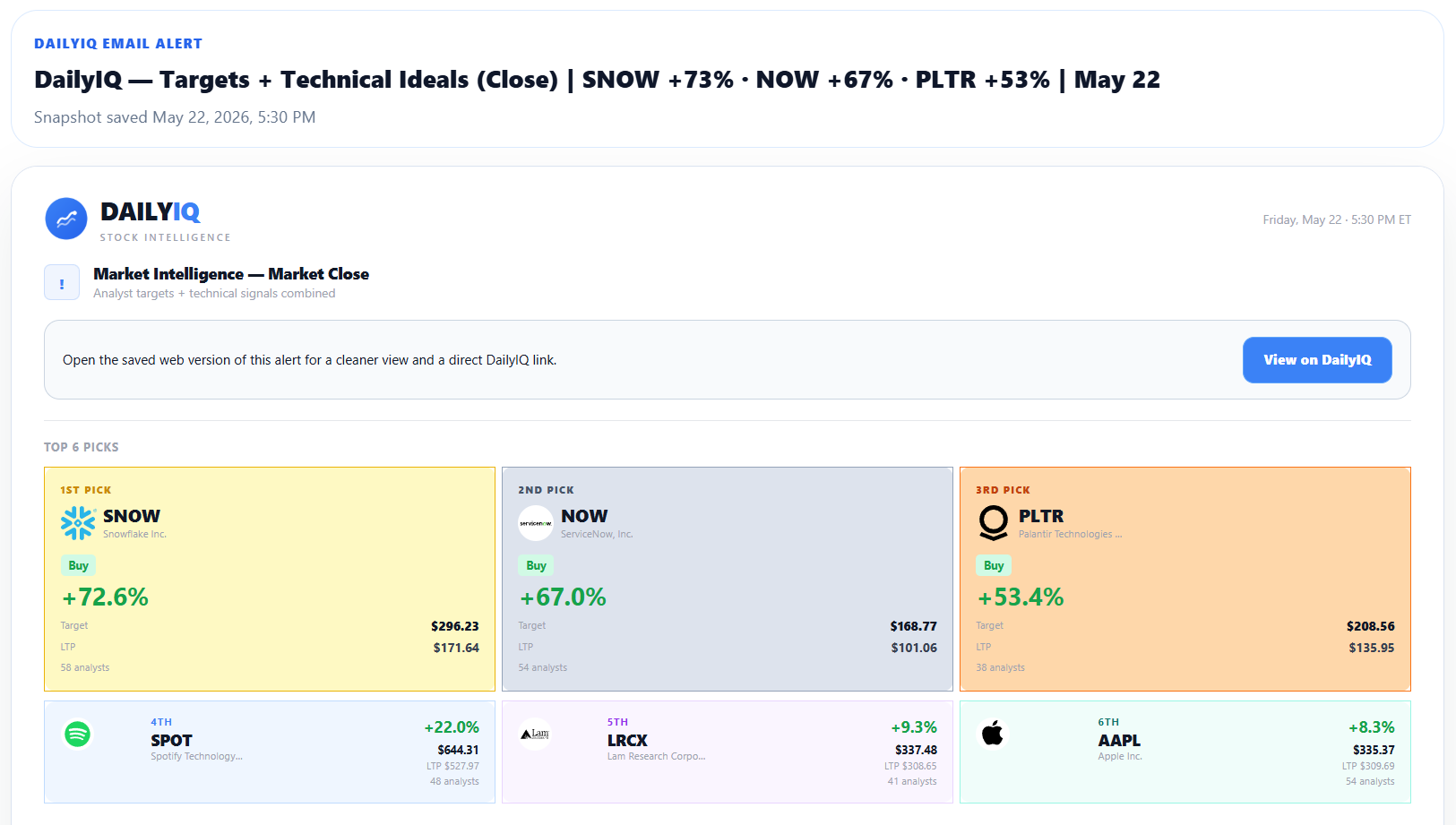
The May 22 example above flagged SNOW, NOW, and PLTR shortly before each ran up roughly 30% over the following week. That is one snapshot, but the pattern shows up elsewhere too:
| Ticker | Flagged at | Current price |
|---|---|---|
| TEAM | $77 | $150 |
| DASH | $170 | $210 |
| SHOP | $100 | $150 |
| ORCL | $115 | $150 |
Most of the gains behind the equity curve below have come directly from acting on DailyIQ alerts:
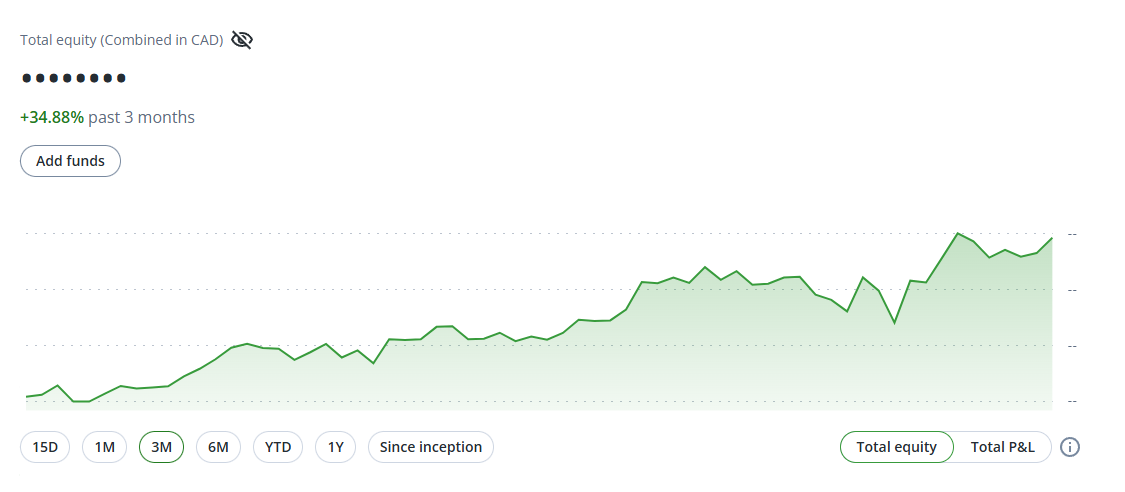
The algorithm is proprietary and it is a tool, not a decision-maker. You are the one making the final call. Do your own due diligence before acting on any alert.
Undervalued beats overbought, even at similar upside
A stock sitting at its 52-week high with 80% projected upside can still be a good buy, but it carries more risk than a beaten-down name with the same upside.
Battered stock, same upside
- Already down from highs, less room to fall further on sentiment alone
- A recovery catalyst plus an upside target gives two reasons to move, not one
Stock at 52-week high, same upside
- Momentum can reverse fast once it stalls
- Upside is priced against a high base, so the same target is a bigger ask
ORCL is a good example. Our algorithm flagged it at $115, at a point when it was down 60% from its highs over the prior month. It now trades around $150. That kind of setup, a battered stock with recovery potential, is a more compelling and lower-risk buy than a stock that is already running hot.
Risk management basics
Before you act on an alert
- Avoid margin and leveraged ETFs
- Know your own risk tolerance and be honest about what losses you can stomach
- Buy in blocks of 100 shares of the US-listed version of a stock when you can
Buying in blocks of 100 shares opens the door to selling covered calls against the position. The calls get sold right away, as soon as the 100 shares are bought, to capture theta decay every week possible. The one thing to watch closely is strike selection: you do not want to get exercised at a price you're not happy with, or at a price below your original purchase cost. In our own trading, this rolling approach has added an extra 20 to 30% in income on top of the stock's own gains.
Putting it together
Key Takeaways
- Use the target price and upside percentage as confidence signals, not hold instructions.
- A 7-10% move in the first 3 days is usually a sell signal, before the fair value gap fills in.
- On slower movers, aim to capture roughly 25 to 30% of the gain, or roll covered calls while you wait.
- If a pick sits flat and you can't roll calls, treat it as a conviction check rather than a reason to panic-sell.
- Be willing to rotate out of a working position into a better opportunity, not just out of a losing one.
- Favor battered, undervalued names over stocks already at highs when the upside is similar.
- Stay off margin and leveraged ETFs, and size positions to your own risk tolerance.
Quick FAQ
Should I hold a stock until it hits the target price in the alert?
No. The target price is a reference point showing the algorithm's read on upside, not an instruction to hold until it is reached. Manage your exit based on how the position actually moves.
What should I do if a stock jumps 7 to 10% in the first few days?
Consider selling. Fast moves like this often leave behind a fair value gap, and when that gap fills, the early gains can disappear.
What if a pick doesn't move at all after I buy it?
If you can sell covered calls against it, a flat stock can still generate weekly income. If you can't, treat it as a signal to dig deeper into the fundamentals and reassess your conviction rather than assuming something is wrong.
How often are DailyIQ email alerts sent?
Twice a day, once before market open and once right before market close.
Are DailyIQ email alerts free?
No, email alerts are a paid subscription feature.
Does DailyIQ tell me exactly when to sell?
Not automatically today. If you want individualized guidance on a specific position, our team is reachable 24/7 through Contact Us.
DailyIQ publishes market education, score methodology, and research workflows to help users understand what the platform is measuring. Content is for informational purposes only and is not investment advice or a recommendation to buy or sell any security.
Use education with process, not in isolation
See how DailyIQ combines technical indicators, news sentiment, freshness checks, and editorial review to decide what gets surfaced and indexed.
Learn About Investing
These resources can help investors evaluate momentum, volatility, and trend strength when analyzing How to Use DailyIQ Email Alerts to Time Your Buys and Sells.
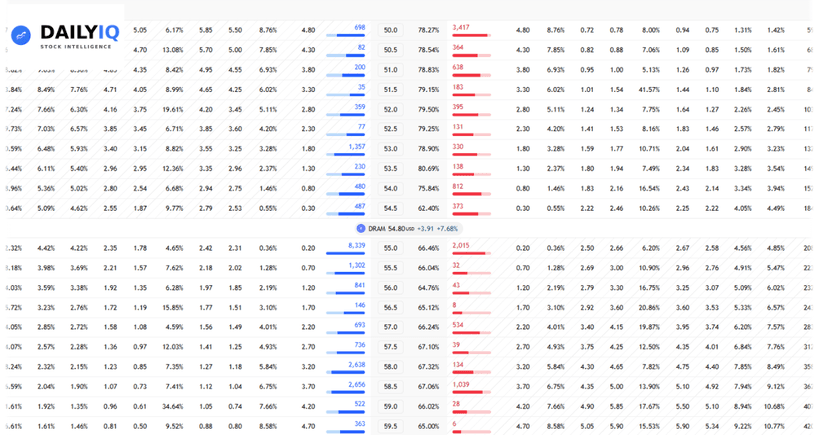 How Covered Calls Work and How to Use Them to Generate IncomeA practical breakdown of how covered calls work, how premium is priced, when to roll or let a call expire, and how they pair with a DailyIQ alert-driven approach.Strategy · 9 min read
 What Is RSI and How to Read ItLearn how the Relative Strength Index helps you measure momentum and identify overbought or oversold conditions.Technical · 16 min read
 Moving Averages: Complete Guide to Trend Identification, Bands, Envelopes, and Breakout ChannelsMaster moving averages from core smoothing mechanics to advanced volatility tools. Learn SMA vs EMA, crossover signals, whipsaws, envelopes, Bollinger/Keltner/STARC bands, Donchian breakouts, and how institutions confirm trends and filter false signals.Technical · 58 min read
 Understanding MACD: A Beginner's GuideLearn how MACD crossovers, histogram momentum, and divergence can help you read trend shifts.Technical · 16 min read