
Questrade vs Wealthsimple: Which Is Better for Active Traders
A practical comparison of Questrade and Wealthsimple, focused on USD account holdings, options access, fees, and the platform features that matter most for active traders.
Introduction To Questrade vs Wealthsimple: Which Is Better for Active Traders
Questrade and Wealthsimple are the two most common self-directed brokers for Canadian investors, and they're built for genuinely different users. This isn't a "which one is objectively better" comparison, it's specifically about what matters if you're actively trading, especially if you're using strategies like covered calls that require holding real USD.
For active and options traders, Questrade wins mainly on one thing: free USD account holding by default, including inside a TFSA. Wealthsimple can match that, but only behind a paid opt-in below $100k in assets, and its FX conversion costs can quietly eat into frequent trading otherwise.
The core difference
Questrade holds real USD in margin, cash, and TFSA accounts free by default. Wealthsimple can too, but only after opting into a paid USD account below $100k in assets.
Where Wealthsimple wins
Simplicity, a cleaner UI, and account perks like a fee-free credit card and banking integration at $100k in assets.
Where Questrade wins
Options access on US-listed shares, no USD holding fees, Questrade Pro's platform depth, and better third-party API connectivity.
The core difference: real USD vs. hedged CDRs
This is the single biggest reason to pick Questrade over Wealthsimple if you're trading actively. Questrade lets you hold true USD balances in your margin account, cash account, and even your TFSA, with no fees for holding US dollars in any of those.
Wealthsimple can also hold USD inside a TFSA, but it's gated: you need a self-directed stock trading TFSA (a managed or robo-advisor TFSA doesn't support this at all), and you have to opt in to a USD account. That USD account costs $10/month unless you qualify as a Premium or Generation client with $100k+ in assets, in which case it's free. Questrade's version of this is free from day one, no opt-in, no asset threshold.
When a US stock is only accessible through its CAD-hedged CDR version instead of the actual US-listed shares, derivative contracts like covered calls simply aren't available on it. If your strategy depends on options, you need the real USD-denominated shares, not the hedged Canadian wrapper.
What each platform actually charges
Both brokers have moved to $0 commissions on stocks, ETFs, and options, so the sticker price looks identical. The real differences show up in the fees that don't show up on the trade confirmation.
| Questrade | Wealthsimple | |
|---|---|---|
| Stock/ETF trades | $0 commission | $0 commission |
| Options, per contract (US equity) | $0 | $0 (since Jan 20, 2026, was up to $2 before) |
| USD account fee | $0, no fee to hold USD | $0 at $100k+ in assets, otherwise $10/month or pay the FX spread per trade |
| CAD to USD conversion | Avoided entirely by holding USD directly, or ~$9 flat fee via Norbert's Gambit | 1.5% standard, tiered down to 0.5% at $25k+ converted, 0% at $100k+ in assets, or ~$9.95 flat fee via Norbert's Gambit (now supported on web) |
| Transfer-out fee | Charged, standard across the industry | $150 per account |
On a $10,000 USD stock purchase, a 1.5% conversion fee works out to roughly $150 on the way in, and another $150 converting back on the way out, around $300 round-trip on a single position. Holding USD directly avoids that entirely. Both brokers now support Norbert's Gambit, buying a dual-listed stock in CAD and journaling it to its USD listing, for a flat fee (~$9 at Questrade, ~$9.95 at Wealthsimple) instead of the percentage-based spread, which beats the FX fee on any meaningfully sized conversion.
Platform and tools
Questrade Pro is a genuinely more robust platform, built for people who want deeper order types, charting, and active-trading tools. It's had a reputation for being less polished than newer fintech apps, but recent updates have been closing that gap.
Wealthsimple's clear advantage is simplicity and a clean UI. If you want an app you can open, place a trade, and close without friction, Wealthsimple is easier to use out of the gate.
Perks beyond the base fees
With per-contract options pricing now a wash between the two, the real differentiators are USD account access and account-level perks.
Questrade
- No fees for holding USD in margin or cash accounts, avoiding the FX spread entirely
- Better third-party API integration, useful for tools like DailyIQ or TradingView
- Generally solid customer support experience
Wealthsimple
- Fee-free credit card and banking integration once you hit $100k in assets
- Simpler account structure for people who don't need active-trading depth
- $0 options pricing across every tier as of January 2026
There have been leaks pointing to Questrade banking as a direct competitor to Wealthsimple's banking integration, though nothing is confirmed or live yet.
US-listed shares vs. CDRs: trading flexibility
Holding the actual US-listed version of a stock instead of its Canadian Depositary Receipt (CDR) gives you meaningfully more flexibility. CDRs are typically closed during after-hours sessions, meaning no price updates and no access to overnight or extended trading sessions. US-listed shares don't have that limitation.
Questrade also tends to have slightly better price fills on orders, though this difference is minor in practice.
Who each one actually fits
Questrade probably fits you if
- You trade options, including covered calls, on US-listed stocks
- You want to hold USD directly, including inside a TFSA
- You trade frequently enough that the 1.5% FX conversion fee would add up
- You want deeper platform tools or third-party integrations
Wealthsimple probably fits you if
- You want the simplest possible interface for buying and holding
- You're not trading options or actively rotating positions
- You're working toward the $100k asset perks like the fee-free credit card
Putting it together
Key Takeaways
- Questrade's biggest structural advantage is free USD account holding by default, across margin, cash, and TFSA, with no opt-in or asset threshold.
- Wealthsimple can hold USD in a self-directed TFSA too, but only after opting into a USD account that costs $10/month below $100k in assets.
- Both platforms now support Norbert's Gambit for a flat ~$9-10 fee, which beats the percentage-based FX spread on any sizable conversion.
- Options, including covered calls, aren't available on CAD-hedged CDR versions of US stocks on either platform.
- Both platforms are now $0 per contract on US equity options as of January 2026, this used to favor Questrade more clearly.
- Wealthsimple wins on simplicity and UI, along with banking perks at higher asset levels.
- Questrade wins on platform depth, API integration, and cost efficiency for frequent US-stock traders.
Quick FAQ
Can I sell covered calls in a Wealthsimple TFSA on a US stock?
Not on the CAD-hedged CDR version. Wealthsimple can hold USD in a self-directed TFSA, but it requires opting into a USD account, which costs $10/month unless you have $100k+ in assets. Questrade's equivalent is free with no opt-in required.
Does Questrade charge fees to hold USD?
No, Questrade doesn't charge fees for holding US dollars in margin or cash accounts.
Which platform has cheaper options trading?
As of January 2026, both are $0 per contract on US equity options. This used to favor Questrade more clearly, but Wealthsimple closed that gap.
What does the Wealthsimple FX fee actually cost?
1.5% standard, tiered down to 0.5% once you've converted $25k or more, and 0% once your total Wealthsimple assets pass $100k. On a $10,000 US stock purchase, that's roughly $150 each way.
Can I use Norbert's Gambit on both platforms?
Yes. Questrade's version costs roughly $9 flat per conversion, and Wealthsimple added support for stock journaling on web for about $9.95 flat. Both beat the percentage-based FX fee on any sizable conversion.
Which platform has better trading tools?
Questrade Pro is the more robust platform for active traders, though Wealthsimple's simpler interface is easier for casual, buy-and-hold use.
DailyIQ publishes market education, score methodology, and research workflows to help users understand what the platform is measuring. Content is for informational purposes only and is not investment advice or a recommendation to buy or sell any security.
Use education with process, not in isolation
See how DailyIQ combines technical indicators, news sentiment, freshness checks, and editorial review to decide what gets surfaced and indexed.
Learn About Investing
These resources can help investors evaluate momentum, volatility, and trend strength when analyzing Questrade vs Wealthsimple: Which Is Better for Active Traders.
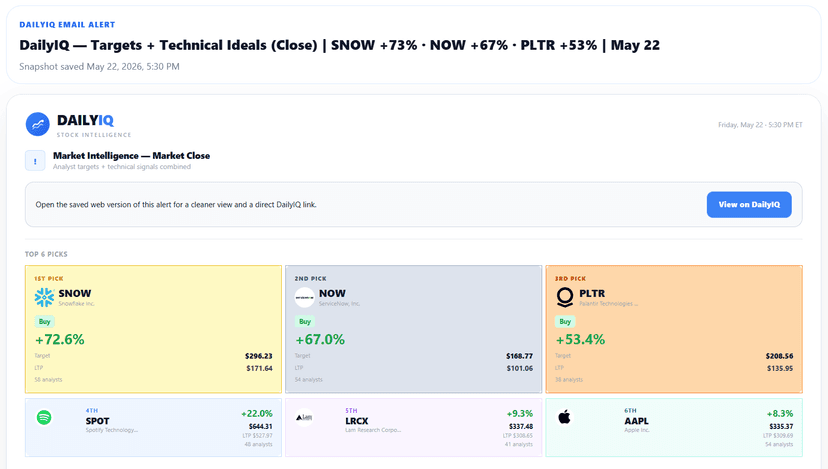 How to Use DailyIQ Email Alerts to Time Your Buys and SellsA practical walkthrough of what's inside a DailyIQ email alert and how to use the target price and upside percentage to time entries, exits, and rotations.Strategy · 9 min read
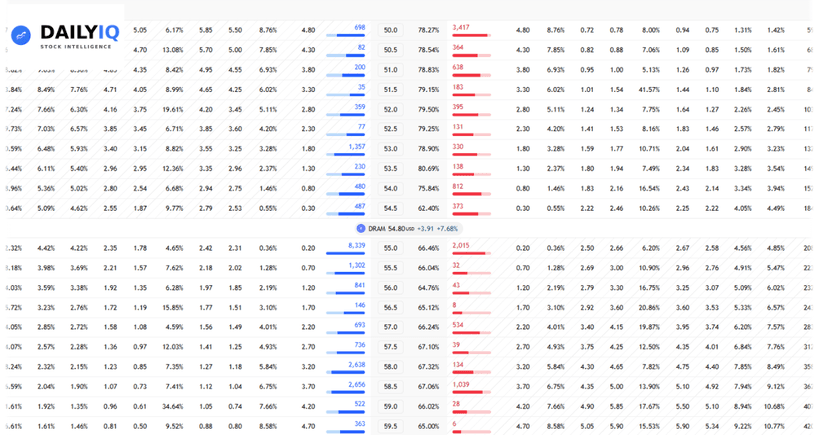 How Covered Calls Work and How to Use Them to Generate IncomeA practical breakdown of how covered calls work, how premium is priced, when to roll or let a call expire, and how they pair with a DailyIQ alert-driven approach.Strategy · 9 min read