
What Are Order Blocks? Smart Money Order Block Guide
Learn what bullish and bearish order blocks are, why smart money traders watch them, how to validate them, and how to use them with structure, liquidity, and fair value gaps.
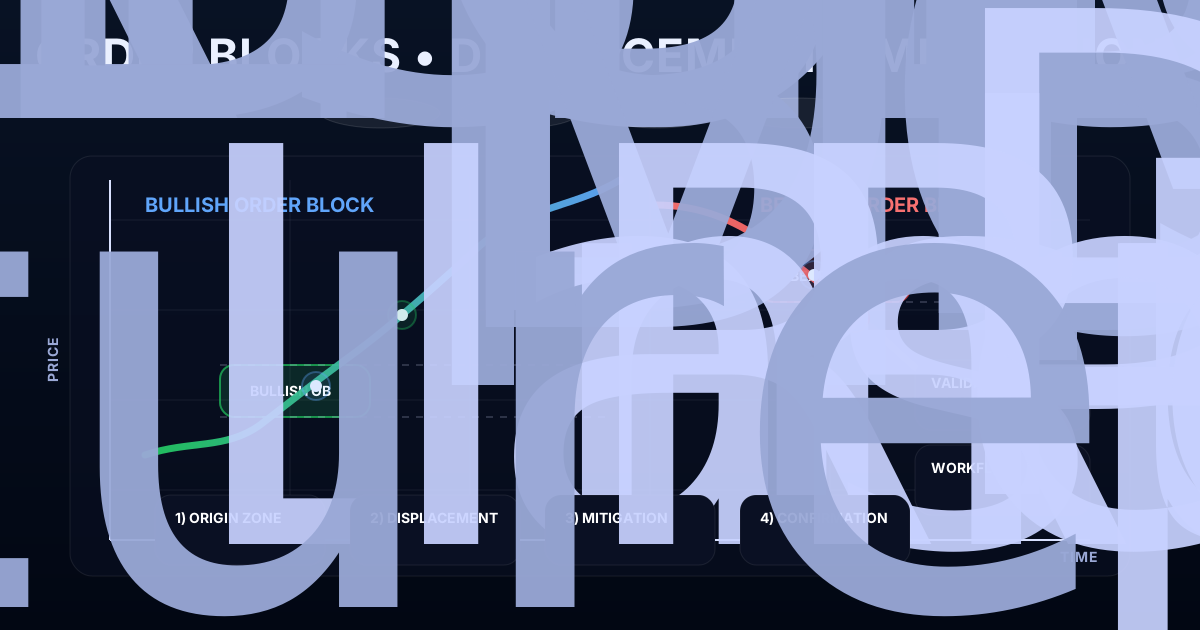
Introduction To Introduction To Order Blocks
Use this guide as a practical framework. An order block is not just any candle before a move. It is a price area that matters because it sits at the origin of institutional displacement.
In smart money trading, order blocks are watched because they may reveal where large participants previously built positions before price moved aggressively away from that area.
Two of the most common forms are:
- Bullish order block → a demand-origin zone that may support price on a pullback
- Bearish order block → a supply-origin zone that may cap price on a rally
Order blocks become much more useful when they are combined with:
- market structure (BOS / CHoCH)
- liquidity (stops above highs or below lows)
- displacement (a strong impulsive move away)
- imbalances / fair value gaps
- higher timeframe context
The key idea:
Order blocks are best treated as context zones, not automatic buy or sell signals.
They help answer practical questions such as:
- Where did price likely rebalance before the impulse?
- If price returns there, does it still react?
- Is the reaction aligned with structure and liquidity?
That is why experienced traders do not simply mark a candle and enter blindly. They wait for the location to make sense.
What an order block actually is (simple definition, strict definition, and why it matters)
An order block is one of the most talked-about ideas in smart money trading, but it is also one of the most misunderstood. Many traders reduce it to a shortcut like “the last red candle before a big green move” or “the last green candle before a big drop.” That shortcut is useful as a starting point, but by itself it is not precise enough to produce consistent analysis. A real order block is better understood as a zone tied to institutional positioning that becomes visible because price leaves that area with clear intent.
The simple definition is this: an order block is the final opposing candle or small cluster of candles before a strong impulsive move. In a bullish case, that means the last down candle before a sharp rally. In a bearish case, that means the last up candle before a sharp selloff. The strict definition adds one more requirement: the move away from that zone should show displacement and should usually create a meaningful structural consequence, such as breaking a relevant swing high or swing low, creating a fair value gap, or sweeping liquidity before expanding.
That distinction matters because not every candle before a move is important. Markets print candles all day. Most of them do not represent meaningful institutional activity. A candle only becomes interesting when it is linked to a larger sequence: liquidity is taken, price displaces, structure changes, and the market later returns to test the origin of that move. That origin zone is where traders begin asking whether the order flow that caused the first expansion might still matter.
This is why experienced traders use order blocks as areas of interest, not automatic entry signals. An order block tells you where something important may have started. It does not prove that the same reaction will happen again. The market might respect the zone, trade through it, partially mitigate it, or invalidate it completely. Context decides which outcome is more likely.
A practical mental model is this:
- Order block = origin zone
- Displacement = proof of importance
- Mitigation = return into the zone
- Reaction = trade opportunity only if confirmation appears
That is also why order blocks work best when paired with other concepts. If the zone sits inside a higher timeframe discount area, aligns with bullish structure, and formed after a liquidity sweep and bullish BOS, it becomes much stronger. If the same zone appears in the middle of a noisy range with no structural consequence, it is far less meaningful.
Bullish and bearish order blocks: how to identify them without turning every candle into a zone
A bullish order block and a bearish order block follow the same logic, but in opposite directions. The bullish version usually appears before price expands upward, while the bearish version usually appears before price expands downward. The problem for most traders is not understanding the direction. The real problem is filtering out weak examples.
A bullish order block is usually the last meaningful down candle, or the final small base of candles, before a sharp upward displacement. That upward move should do something important. Ideally it should break above a relevant swing high, reclaim structure after a sweep, or leave behind a fair value gap. If price only drifts upward a little, that is usually not enough. Strong bullish order blocks tend to be followed by decisive movement that shows demand overcame nearby supply.
A bearish order block is the opposite. It is usually the last meaningful up candle, or small consolidation, before a sharp downward displacement. That selloff should ideally break a relevant swing low, confirm bearish continuation, or shift behavior after a liquidity run. A weak fade lower is not the same thing as bearish displacement. If the move away is slow and overlapping, the zone is usually less useful.
The best identification process is not “find candle first.” It is “find the impulse first, then trace back to the origin.” That order matters. Start by locating the real displacement leg. Ask whether that leg broke structure, created imbalance, or came after taking liquidity. Then mark the last opposing candle or base that clearly sits at the origin of that move.
Here are practical filters that improve accuracy:
- The move away should be visually obvious
- The move should have consequences for structure
- The zone should be near a meaningful swing or liquidity point
- The zone should be visible on the timeframe you are trading
- The return should not already have over-mitigated the zone several times
This last point is important. A fresh order block is usually more interesting than one that has been touched three or four times already. Each revisit can reduce the edge because the original imbalance may already have been rebalanced.
Traders also disagree on whether to mark the full candle range or only the body. A common practical approach is to start with the full candle range, then note the body as the more aggressive sub-zone. That lets you treat the wick as the broader area and the body as the refined entry section.
The biggest mistake is marking too many zones. On almost any chart, you can create ten bullish and bearish rectangles if you want to. That does not mean they all matter. Order blocks become useful only when they are tied to location, displacement, and structure. Without those filters, order block analysis becomes drawing instead of decision-making.
What makes an order block valid: displacement, liquidity, BOS, mitigation, and reaction quality
The quality of an order block is determined less by how clean the candle looks and more by what happened around it. This is where smart money logic becomes practical. A valid order block is not defined by shape alone. It is defined by the behavior that formed it and the behavior that follows when price comes back.
The first validation factor is displacement. If price leaves the zone with speed, range expansion, and clear directional intent, that tells you the area mattered. Displacement often shows up as a large-bodied candle sequence, a visible imbalance, or a strong move through nearby liquidity. Without displacement, the zone may simply be ordinary market noise.
The second factor is liquidity context. Strong order blocks often form after price sweeps an obvious high or low, clears equal highs or lows, or taps a level where stops are likely resting. That sequence matters because institutions often need liquidity before price can travel efficiently. When a bullish order block forms after sell-side liquidity is taken and price then displaces upward, the narrative is much cleaner than a random green move from the middle of nowhere.
The third factor is market structure. A bullish order block becomes more meaningful if the move away leads to bullish BOS or helps confirm a CHoCH sequence. A bearish order block becomes stronger if the move away breaks a relevant swing low or confirms bearish continuation. This is one of the best filters because it forces the zone to matter at the swing level, not just the candle level.
The fourth factor is mitigation behavior. An order block often becomes tradable when price returns to it. That revisit is called mitigation. But not all mitigations are equal. Strong reactions often show one or more of the following:
- rejection wicks from the zone
- lower timeframe CHoCH in the expected direction
- immediate reclaim of the midpoint or body
- follow-through after tap
- respect of a nested FVG inside the block
A weak mitigation is when price enters the zone, stalls, and trades through it without a decisive reaction. That does not automatically mean the idea is wrong, but it reduces confidence.
The fifth factor is freshness. A newly formed order block that has not yet been tested usually has more interest than an old zone that price has repeatedly traded into. Every revisit can rebalance more of the inefficiency that made the zone attractive in the first place.
A simple scoring model for DailyIQ could look like this:
- displacement present
- BOS or CHoCH linked
- liquidity sweep before move
- FVG created in impulse
- first or second mitigation only
- higher timeframe alignment
The more of those conditions that are present, the more credible the order block becomes. This is how the concept moves from social-media pattern talk to a realistic analytical framework.
How to trade order blocks with a real workflow: higher timeframe bias, lower timeframe confirmation, entries, and invalidation
Order blocks are easiest to use when they are part of a sequence rather than a standalone signal. The cleanest workflow begins with the higher timeframe. Start on the 4H or Daily chart and ask where the market is in its broader auction. Is the market trending, ranging, or transitioning? Where are the obvious liquidity pools? Is price near premium or discount relative to the current swing range? Once you know that, order blocks stop being random rectangles and start becoming location-based ideas.
Suppose the higher timeframe is bullish. Price may be pushing upward overall, but eventually it pulls back. That is where a bullish order block becomes interesting. Instead of buying blindly anywhere inside the zone, drop to a lower timeframe such as 15m or 5m and wait for confirmation. That confirmation might be a liquidity sweep inside the zone followed by bullish CHoCH, a small internal BOS upward, or a sharp rejection candle that immediately reclaims part of the block. The point is that the order block gives location, while the lower timeframe gives timing.
There are several entry models traders commonly use:
Model 1: Limit-style entry at the order block
This is the most aggressive approach. The trader marks the zone and places an entry inside it, often at the open, midpoint, or body of the candle. This gives the best price but the lowest confirmation.
Model 2: Tap and confirm
Price returns to the order block, then the trader waits for a lower timeframe CHoCH or BOS in the expected direction. This usually sacrifices some entry quality in exchange for more confirmation.
Model 3: Order block + FVG overlap
If the order block overlaps with a fair value gap or sits near discount in a bullish setting or premium in a bearish setting, the trade becomes more attractive. The trader then waits for reaction and enters on confirmation.
Invalidation should always be structure-based. For a bullish order block, invalidation often sits below the low of the block, below the sweep low that led to the reversal, or below the swing low whose defense is necessary for the thesis to remain valid. For a bearish order block, invalidation usually sits above the high of the block or above the swing high tied to the idea. Random stop distances make order blocks much less useful.
Targets should also be logical. Common targets include opposing liquidity, prior swing highs or lows, an unfilled imbalance, or the next external structure point. In other words, you do not only need a reason to enter. You also need a reason to expect price to move from the zone toward something objective.
Common mistakes with order blocks, plus how DailyIQ can detect and score them realistically
The biggest reason traders struggle with order blocks is not that the concept is fake. It is that they use it too loosely. The most common mistake is drawing an order block on every candle before a move. That makes the chart look busy, but it does not improve decision quality. A zone becomes meaningful only if it is tied to displacement and a structural event. Without that, the trader is just marking history.
The second mistake is trading every first touch. Fresh zones can be powerful, but first touch alone is not a complete edge. Markets often partially mitigate a block, overshoot it, or trade through it before the real reaction happens. Traders who buy or sell instantly at every touch usually discover how noisy price can be. Confirmation matters, especially in volatile markets and especially on lower timeframes.
The third mistake is ignoring the broader trend. A bearish order block inside a strong daily uptrend may still work as a short-term reaction zone, but it is not the same as a high-conviction reversal area. Likewise, a bullish block inside strong bearish external structure may only produce a brief bounce. This is why higher timeframe context must come first.
The fourth mistake is confusing order blocks with supply and demand zones without any additional rules. The concepts overlap, but smart money order block logic is usually more specific because it links the zone to a displacement origin and a structure event. If that link is missing, the zone may still matter, but it is no longer a strong order-block setup in the strict sense.
The fifth mistake is failing to define mitigation depth. Some traders consider a block invalid the moment price trades one tick into it. Others allow full-candle mitigation and still consider it valid if the move closes back out. DailyIQ should solve this by being explicit. For example:
- first touch = fresh
- body tap = moderate mitigation
- full-range tap = deep mitigation
- clean close through = invalidation or severe weakening
A realistic DailyIQ scoring system for order blocks could include:
- higher timeframe alignment
- external or internal structure link
- displacement strength
- presence of nearby liquidity sweep
- fair value gap overlap
- mitigation freshness
- lower timeframe confirmation
- reaction strength after touch
Then, instead of outputting something simplistic like “Bullish order block = buy,” the platform can say:
- “Bullish order block detected, but against external trend”
- “Fresh bearish order block with displacement and BOS confirmation”
- “Order block mitigated; waiting for lower timeframe reclaim”
- “Zone weakened after repeated tests”
That style is far more useful and far more honest. It teaches users that order blocks are not guarantees. They are structured clues about where price previously moved with intent and where reactions may still matter if the surrounding context supports the idea.
Displacement Is the Qualifying Factor
An order block without displacement is just a candle. What makes a zone meaningful is the strong, impulsive move that followed - one that broke structure, left an imbalance, or swept liquidity before expanding. If the move away from the zone was slow and choppy, the zone probably does not carry institutional significance and is better skipped.
Fresh Mitigation Matters
An order block loses much of its relevance once price has already traded back into it and reacted. The cleanest setups come from the first visit back into a zone after the initial displacement. Repeated visits often mean the zone is being absorbed rather than defended, and the reaction probability decreases with each return.
Confirmation Before Entry
Entering an order block touch-only - without waiting for a reaction signal - is an aggressive approach that works less often than it appears to in backtests. A lower timeframe shift in structure, a rejection wick, or a close back above the zone with momentum all provide cleaner confirmation that the zone is actually defending before you commit capital.
Quick FAQ
Is an order block just the last candle before a move?
Not by itself. That shortcut is incomplete. A stronger order block is tied to displacement, structure, and often liquidity.
What is a bullish order block?
It is usually the last meaningful down candle or small base before a strong move up, especially when that move breaks structure or creates imbalance.
What is a bearish order block?
It is usually the last meaningful up candle or base before a strong move down, especially when that move breaks relevant support or shifts structure.
Should I enter as soon as price touches an order block?
Many traders prefer to wait for confirmation. Touch-only entries are more aggressive and often more vulnerable to fakeouts.
What makes an order block stronger?
Displacement, liquidity context, BOS or CHoCH, fresh mitigation, higher timeframe alignment, and overlap with an FVG all improve quality.
DailyIQ publishes market education, score methodology, and research workflows to help users understand what the platform is measuring. Content is for informational purposes only and is not investment advice or a recommendation to buy or sell any security.
Use education with process, not in isolation
See how DailyIQ combines technical indicators, news sentiment, freshness checks, and editorial review to decide what gets surfaced and indexed.
Learn About Investing
These resources can help investors evaluate momentum, volatility, and trend strength when analyzing What Are Order Blocks? Smart Money Order Block Guide.
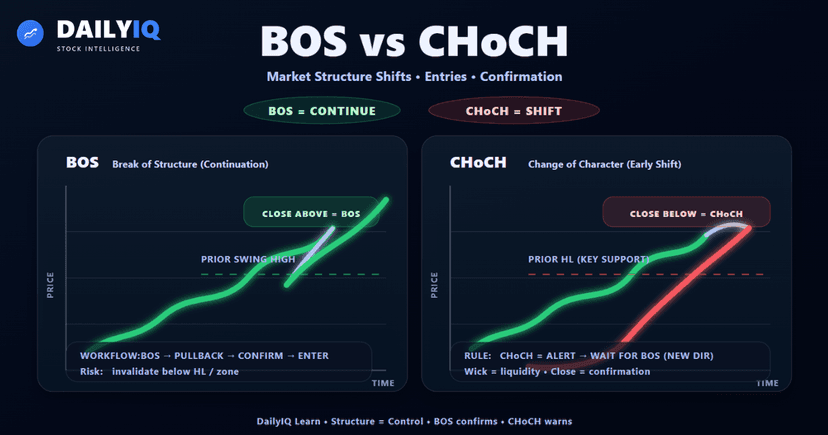 Break of Structure (BOS) and Change of Character (CHoCH) ExplainedLearn how Break of Structure (BOS) and Change of Character (CHoCH) reveal trend continuation and reversals - and how smart money traders use them with liquidity and imbalances.Technical · 23 min read
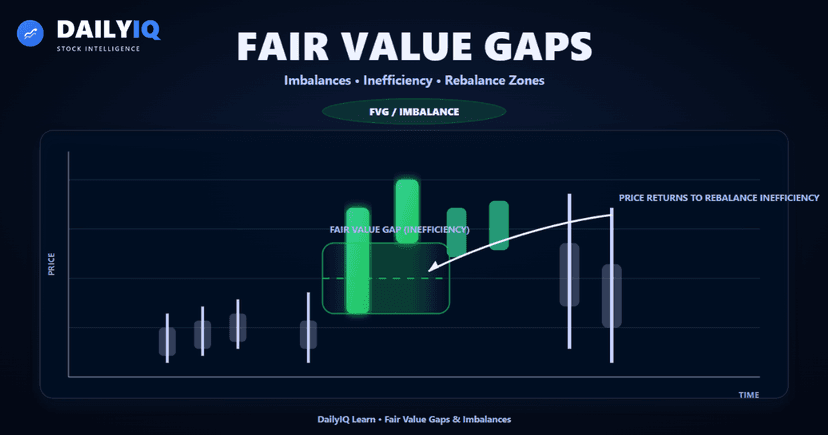 Fair Value Gaps, Imbalances, and Supply Demand Inefficiencies ExplainedLearn how Fair Value Gaps (FVG), imbalances, and supply-demand inefficiencies form, why price revisits them, and how to use them for structured entries and risk.Technical · 22 min read
 What Is ATR and How to Use ItLearn how the Average True Range (ATR) measures volatility and helps you set smarter stop losses and position sizes.Volatility · 16 min read
 What Is EMA and How to Read ItLearn how the Exponential Moving Average helps you identify trend direction, momentum shifts, and dynamic support or resistance.Technical · 16 min read