
Break of Structure (BOS) and Change of Character (CHoCH) Explained
Learn how Break of Structure (BOS) and Change of Character (CHoCH) reveal trend continuation and reversals - and how smart money traders use them with liquidity and imbalances.
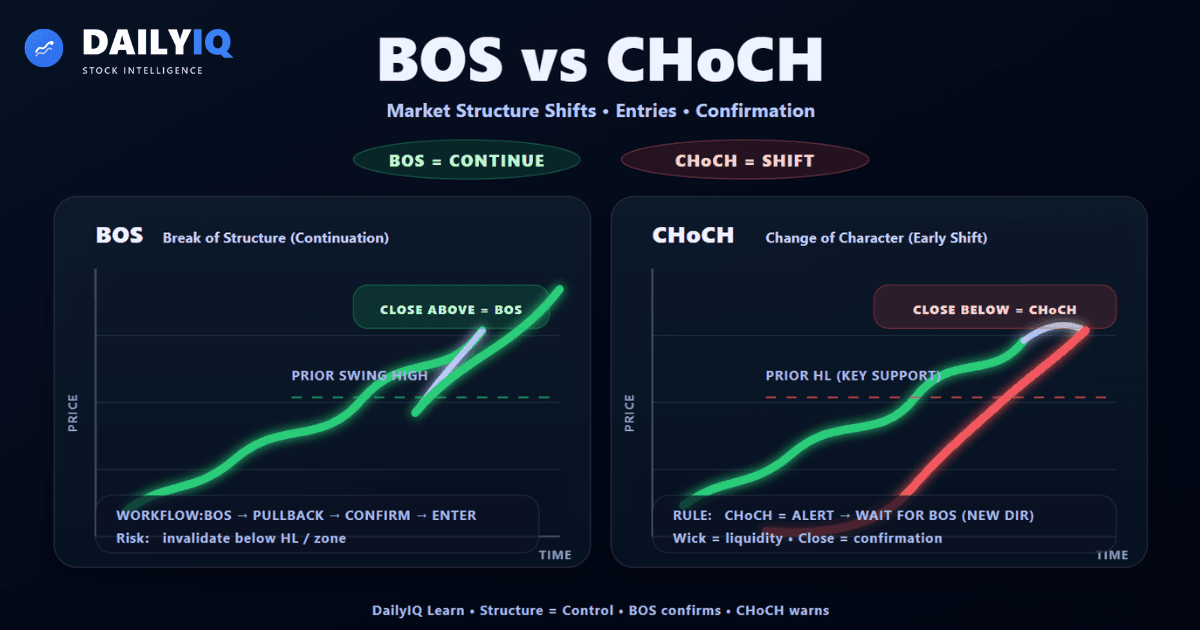
Introduction To BOS and CHoCH
Use this guide as a practical framework. BOS and CHoCH are not "signals" by themselves. They are structure events that tell you what price is doing at the swing level.
Two of the most useful market structure concepts used by institutional-style traders are:
- Break of Structure (BOS) -> continuation confirmation
- Change of Character (CHoCH) -> early warning of reversal or regime shift
They help answer two important questions:
- Is the trend still intact?
- If not, is the market starting to behave differently?
The key idea:
Structure is about swing points (highs and lows). When those points break, something changes in how price is auctioning liquidity.
Smart money traders focus on these breaks because large participants generally need:
- liquidity to enter
- liquidity to exit
- and predictable areas to rebalance (e.g., previous highs/lows, imbalances)
BOS and CHoCH help define those areas and the moments when the market transitions.
Core definitions (simple and strict)
Market structure in one sentence
Market structure is the sequence of swing highs and swing lows.
A trend is defined by whether swings are progressing:
- Uptrend -> higher highs (HH) and higher lows (HL)
- Downtrend -> lower lows (LL) and lower highs (LH)
- Range -> swings overlap without progression
Break of Structure (BOS)
A BOS happens when price breaks a relevant swing in the direction of the prevailing trend.
- In an uptrend: BOS = break above a prior swing high (HH continuation)
- In a downtrend: BOS = break below a prior swing low (LL continuation)
BOS is often interpreted as "continuation confirmation."
Change of Character (CHoCH)
A CHoCH happens when price makes the first meaningful break against the prior trend.
- In an uptrend: CHoCH often appears as a break below a prior HL
- In a downtrend: CHoCH often appears as a break above a prior LH
CHoCH is best treated as a warning sign, not an automatic reversal signal.
The hierarchy idea:
- CHoCH = first crack in the trend
- BOS (after CHoCH) = confirmation that a new direction may be forming
What counts as a real swing (and why it matters)
Structure breaks only mean something if the swing being broken is relevant.
A common problem:
Traders mark every tiny zig-zag as "structure" and then see BOS/CHoCH everywhere. That creates noise.
A practical rule:
A swing high/low is more relevant if it has at least one of these properties:
- It caused a clear displacement move
- It sits near a key level (previous day high/low, major support/resistance)
- It was formed after consolidation (range -> breakout)
- It is visible on a higher timeframe (4H/1D)
- It is linked to liquidity (a place where stops would logically sit)
Smart money traders care about relevance because large orders interact around liquidity pools.
If a swing is not linked to liquidity, breaking it often does not change behavior.
BOS in an uptrend: continuation logic
In an uptrend, the market typically behaves like this:
- Price makes a higher high (HH)
- Pulls back to form a higher low (HL)
- Then breaks above the prior HH -> BOS
That break matters because it confirms demand is still strong enough to:
- absorb supply at the previous high
- take liquidity above that high (stops and breakout orders)
- push price into new territory
Smart money traders often use BOS as a confirmation step before looking for pullback entries.
A common workflow:
- Identify uptrend structure
- Wait for BOS above a relevant swing high
- Mark the imbalance / FVG created during the break
- Wait for pullback into the zone
- Enter after confirmation
CHoCH: the first meaningful break against trend
CHoCH is a "behavior change" concept.
In an uptrend, price usually respects higher lows. When the market breaks below a prior HL, it suggests:
- buyers are not defending the pullback level
- selling pressure is increasing
- liquidity below the HL has been taken
That can be the start of:
- a deeper pullback (not necessarily a reversal)
- a transition into range
- or a full reversal if followed by confirmation
Smart money traders often interpret CHoCH like this:
CHoCH = alert mode
Not "short immediately."
They wait to see if the market can then produce a BOS in the opposite direction to confirm a new bearish structure.
BOS vs CHoCH: the best mental model
If you remember only one thing:
- BOS = continuation confirmation
- CHoCH = warning of transition
A strong institutional-style sequence is often:
- Trend exists (HH/HL or LL/LH)
- CHoCH happens (first break against trend)
- Price pulls back and forms a new swing
- BOS happens in the new direction -> confirms regime shift
This is why many traders do not trade CHoCH alone.
CHoCH tells you something changed.
BOS tells you the new direction is becoming dominant.
Valid breaks: wick vs close (and why traders disagree)
Not all breaks are equal.
A major reason traders get inconsistent results is disagreement on what counts as a "break":
Wick break
Price spikes above/below a swing briefly (liquidity run), then returns.
- Pro: earlier signal
- Con: more fakeouts
Close break
Price closes beyond the swing on the chosen timeframe.
- Pro: more reliable confirmation
- Con: later entry
Institutional-style traders often prefer close confirmation for structure, because it reduces false signals caused by stop runs.
A practical compromise:
- Use wick as "liquidity taken" (information)
- Use close as "structure broken" (confirmation)
This is especially useful when combining BOS/CHoCH with imbalances (FVG) and liquidity.
How smart money traders combine BOS/CHoCH with liquidity
Large participants care about liquidity because they need counterparties.
A classic institutional-style idea:
- Liquidity sits above swing highs (buy stops)
- Liquidity sits below swing lows (sell stops)
So you often see:
- Price runs liquidity (wicks a level)
- Then structure breaks the other way (CHoCH)
- Then a BOS confirms the new direction
- Price rebalances into an imbalance (FVG) or supply/demand zone
- Continuation follows
This is why BOS/CHoCH is powerful:
It helps you separate liquidity events from real trend shifts.
Without structure, liquidity runs look confusing.
With structure, they become readable.
Entry models: three clean ways to trade BOS/CHoCH
BOS/CHoCH becomes tradable when you add a clear entry model.
Here are three practical models used by structure-based traders:
Model 1: BOS -> pullback -> continuation
- Identify trend
- Wait for BOS
- Mark the imbalance / FVG created in the BOS leg
- Wait for pullback into the zone
- Enter after confirmation
Best for: trend continuation.
Model 2: CHoCH -> pullback -> confirm -> reversal attempt
- Identify a mature trend (extended move, multiple pushes)
- Wait for CHoCH (first meaningful break against trend)
- Wait for pullback (often into an imbalance)
- Enter only if price rejects and structure holds
Best for: early reversal attempts (higher risk).
Model 3: CHoCH + BOS confirmation (safer reversal model)
- Wait for CHoCH
- Then wait for BOS in the new direction
- Then trade pullback after confirmation
Best for: safer reversals (lower reward but higher reliability).
Most traders do best starting with Model 1 and Model 3.
Risk management: invalidation rules that actually make sense
Structure trading is only clean if your invalidation is clean.
Good invalidation answers:
"What would prove my structure idea wrong?"
Examples:
Trend continuation (after BOS)
If bullish:
- invalidation may be below the pullback swing low (HL)
- or below the zone (imbalance/FVG) you're using
Reversal attempt (after CHoCH)
If bearish reversal attempt:
- invalidation may be above the recent swing high that caused the CHoCH
- or above the supply zone / imbalance used for entry
A key best practice:
Use structure-based stops, not random stop distances.
Then use ATR/volatility only to sanity check if your stop is too tight relative to noise.
Multi-timeframe workflow (the cleanest way to avoid noise)
Smart money structure analysis is usually multi-timeframe:
Step 1: Higher timeframe sets regime
Use 4H or Daily to define:
- overall trend
- major swing highs/lows
- major liquidity pools
Step 2: Lower timeframe provides execution
Use 15m / 5m to:
- see the CHoCH/BOS sequence clearly
- time pullbacks into zones
- reduce stop size (with structure invalidation)
Core rule:
HTF gives direction + important structure. LTF gives timing + precision.
Common mistakes (and how to fix them)
Mistake 1: Calling every break a BOS
If the market is in a range, breaking small swings is not BOS - it's noise. Fix: only label BOS on relevant swings aligned with HTF context.
Mistake 2: Trading CHoCH like a reversal trigger
CHoCH is an alert, not proof. Fix: use CHoCH -> wait for confirmation (BOS in new direction or clear rejection structure).
Mistake 3: No confirmation / no close rule
Wick hunts create false signals. Fix: treat wick as liquidity, treat close as structure confirmation.
Mistake 4: Ignoring liquidity
Structure breaks without liquidity context can be random. Fix: note where stops likely sit and whether they were taken before the break.
Mistake 5: Not defining invalidation
Without invalidation you turn structure trading into guessing. Fix: decide exactly what level breaks your thesis.
How DailyIQ can score BOS/CHoCH (realistically)
A strong way to integrate BOS/CHoCH into DailyIQ is to treat them as structure signals that increase confidence when aligned with other context:
- Trend alignment (EMA structure, HTF direction)
- Volatility regime (ATR rising/falling)
- Liquidity proximity (near prior highs/lows)
- Presence of imbalance (FVG) created by displacement
- Confirmation rule (close break, reclaim, BOS after CHoCH)
Instead of: "CHoCH = sell now"
DailyIQ can output: "Structure shift detected - wait for confirmation."
That makes the system more stable and less hype-driven.
Best practices checklist
- Start with higher timeframe structure (4H/D)
- Label only relevant swings (not micro noise)
- BOS = continuation; CHoCH = warning
- Prefer close confirmation for structure breaks
- Track liquidity runs (wicks) as context, not confirmation
- Use BOS -> pullback entries for cleanest execution
- Define invalidation before entering
- Keep risk fixed and consistent
BOS/CHoCH is powerful because it turns charts into a readable sequence of control shifts - but only if you apply it consistently.
BOS Confirms Continuation - CHoCH Signals Caution
These two concepts answer different questions. BOS tells you the trend is still behaving as expected - the sequence of swing highs and lows is intact. CHoCH tells you the first structural evidence that behavior has changed. Knowing which event you are looking at prevents reacting to normal trend movement as if it were a reversal.
Wait for Close Confirmation
Wick-based structure breaks are common as liquidity runs and often do not represent genuine auction control shifts. A candle close beyond the swing level is a more reliable confirmation than a wick touch. Many false BOS and false CHoCH readings disappear entirely when you require close rather than wick confirmation before calling the break valid.
CHoCH Alone Is Not a Trade Entry
A single CHoCH is a warning flag, not a reversal signal. The most reliable reversal sequences include a CHoCH, followed by a pullback into an area of interest like an FVG or order block, followed by a BOS in the new direction. Entering on CHoCH alone, without that subsequent confirmation, is one of the most common structure-trading mistakes.
Quick FAQ
Is CHoCH a reversal signal?
Not by itself. CHoCH is best treated as an alert that behavior changed. Many traders wait for BOS in the new direction to confirm a true regime shift.
What is the difference between BOS and CHoCH?
BOS breaks structure in the trend direction (continuation). CHoCH is the first meaningful break against the prior trend (transition warning).
Should I use wick or close breaks?
Wick breaks often represent liquidity runs. Close breaks are typically more reliable confirmation for structure. Many traders track both: wick as context, close as confirmation.
What timeframe is best for BOS/CHoCH?
Higher timeframes define the real regime and major swings. Lower timeframes help time execution. A common combo is 4H/D for structure and 15m/5m for entries.
Why do I see BOS everywhere in a range?
Because you're likely labeling micro swings. In ranges, structure breaks frequently without meaning. Use relevance filters and higher timeframe context.
Who is near their 52-week extremes today
Across the 1,102 symbols DailyIQ currently tracks with this metric, the median reads 43.9%. The middle 80% of the market sits between 4.85% and 87.6%, with the full range running from 0% to 100%. Right now 86 symbols read above 90% and 186 below 10% — which is the practical answer to how common that condition actually is, rather than how common the textbook implies.
Computed across DailyIQ's tracked universe and refreshed through the trading day. Figures describe the current cross-section, not a recommendation.
Definition and thresholds: 52-Week High/Low
DailyIQ publishes market education, score methodology, and research workflows to help users understand what the platform is measuring. Content is for informational purposes only and is not investment advice or a recommendation to buy or sell any security.
Use education with process, not in isolation
See how DailyIQ combines technical indicators, news sentiment, freshness checks, and editorial review to decide what gets surfaced and indexed.
Learn About Investing
These resources can help investors evaluate momentum, volatility, and trend strength when analyzing Break of Structure (BOS) and Change of Character (CHoCH) Explained.
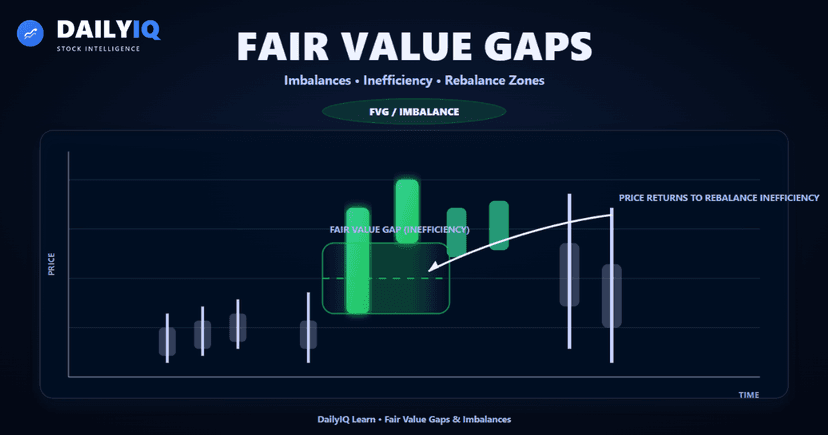 Fair Value Gaps, Imbalances, and Supply Demand Inefficiencies ExplainedLearn how Fair Value Gaps (FVG), imbalances, and supply-demand inefficiencies form, why price revisits them, and how to use them for structured entries and risk.Technical · 22 min read
 What Is ATR and How to Use ItLearn how the Average True Range (ATR) measures volatility and helps you set smarter stop losses and position sizes.Volatility · 16 min read
 What Is EMA and How to Read ItLearn how the Exponential Moving Average helps you identify trend direction, momentum shifts, and dynamic support or resistance.Technical · 16 min read
 What Are Heikin Ashi Candles and How to Read ThemLearn how Heikin Ashi candles smooth price action to help you identify trend strength, momentum shifts, and cleaner entries.Technical · 6 min read
 What Are Order Blocks? Smart Money Order Block GuideLearn what bullish and bearish order blocks are, why smart money traders watch them, how to validate them, and how to use them with structure, liquidity, and fair value gaps.Technical · 24 min read